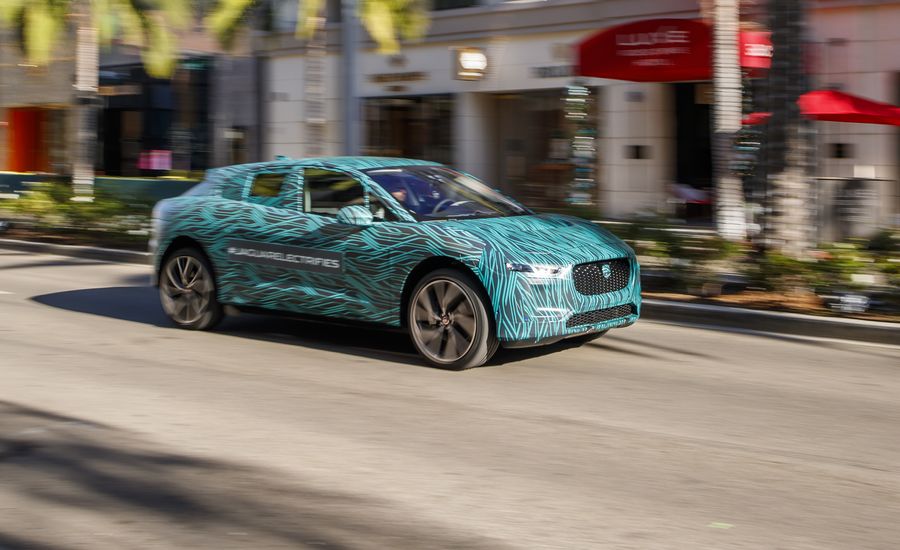
The I-Pace is Jaguar’s first electric vehicle, and although it’s still months away from showrooms, we got a ride in a preproduction prototype built using the final tooling. Jaguar isn’t doing the final assembly forthe I-Pace; instead, Magna Steyr, the contract builders of the Mercedes-Benz G-class and the BMW 5-series, will screw them together in Graz, Austria. Despite not driving the Jag ourselves—that will come later—we did learn a bit more about the I-Pace even as company executives remain largely tight lipped regarding final specs, how much it will cost, how quickly it will charge, and whether Jaguar will be making any infrastructure investments like Tesla.
The I-Pace will go on sale late next summer in Europe and should arrive in the United States in the fall. Most of the stats that Jaguar would discuss were lifted directly fromthe concept version shown a year ago. A range of more than 200 miles is promised, made possible by a 90.0-kWh battery pack that uses pouch-type lithium-ion cells. Jaguar is employing an outside supplier for its batteries; we’re guessing it’s Panasonic, given the Panasonic/Jaguar partnershipin the Formula E electric racing series. In contrast, the two identical electric motors that move the I-Pace were designed in-house. One is located up front and the other at the rear, each independently driving an axle; together they provide all-wheel drive and a default 50/50 front-to-rear torque split that can be altered to adapt to slippery conditions. The motors also can perform this trick in the interest of efficiency. Each motor is good for 200 horsepower and 258 lb-ft of torque, for totals of 400 horses and 516 lb-ft.
VIEW 28 PHOTOS
Despite the camouflage wrap concealing the look of the crossover’s aluminum body, we could see that the I-Pace has an interesting vent in the hood that allows air to pass over the exit of the radiators and help extract heat while, according to Jaguar, improving aerodynamics—a 0.29 drag coefficient is claimed. If you’re wondering why an EV has a radiator at all, the answer is that an EV’s battery needs to be cooled to remain in its optimal operating-temperature range, as they can generate a lot of heat when they’re being charged or quickly discharged. In this case, Jaguar’s solution is liquid cooling via coolant, a radiator, and a circulating pump.
From the passenger seat, the I-Pace experience is pretty typical of most electric cars. There’s a largely hushed whirring from the motors—in the prototype this sound became particularly loud when the I-Pace was decelerating and recharging its battery via regenerative braking, although Jaguar tells us that the production version may be quieter. Speaking of regenerative braking, two selectable modes are available. The first is more conventional, meaning you need to use the brake pedal more often, while the second is more aggressive and allows you to drive using only the accelerator. Lifting off the throttle provides enough braking force to slow the vehicle without having to apply the four-wheel disc brakes. The ride from the air-spring-equipped I-Pace we rode in was supple despite the large 22-inch wheels wrapped in 255/40 Pirelli P Zero tires.
Acceleration is quick and, as in a Tesla Model S, the power hits right away. Jaguar claimed a zero-to-60-mph time of 4.0 seconds when the concept was unveiled, and we have no reason to doubt that time. Inside, the seats are comfortable and there’s a decent amount of rear-seat space—about what you might find in Jaguar’s mid-size F-Pace crossover. Large pieces of cloth camouflage were draped over the interior, but we could see a touchscreen that appears to be shared with the rest of the Jaguar lineup.
Oh, and why is this vehicle called the I-Pace, when E-Pace—the name Jaguar is using forits new, conventionally powered compact SUV—seems to make more sense? The reason is that Jag’s Formula E race car is called the I-type, so the brand’s electric vehicles will get the letter I instead of the letter E. We still think E-Pace would be a better fit, but with that burning question answered, we now must wait until the I-Pace officially debuts in March to see the final styling and learn the rest of the details.
The greatest pleasure to be found in Porsche’s 982-chassis 718 Boxster and 718 Cayman exists between the edge of grip and the edge of control. It’s a place of pure joy thanks to the sweetest stability-control system in existence—one that lets you look over the edge without actually jumping, but which also never punishes you for doing so. These are machines we’ve appreciated for years now, approving enough of Porsche’s least costly sports car in either its roadster or coupe forms (or both) to award them 19 10Best Cars awards—including a 2018 honor. The newest version of the cars, the GTS, makes the experience even more enlightening.
he GTS designation isn’t new, having first appeared on the 904 Carrera GTS in 1963. The modern formula for GTS models is to add the performance features available elsewhere as options and package them with a modest bump in power for an all-in price better than it would cost to piece everything together. And that’s exactly what the Boxster and Cayman GTS models accomplish once again, their starting prices of $82,950 and $80,850 representing a value over comparably equipped S models.
The Goods
Standard equipment includes all the hardware a serious driver would order anyway: the Sport Chrono package, Sport exhaust, PASM adaptive dampers, Sport Seats Plus, brake-based Porsche Torque Vectoring, 20-inch wheels, and an interior with microsuede applied strategically for both function and beauty. Plus, the turbocharged 2.5-liter flat-four has an additional 15 horsepower relative to the S model Boxster and Cayman, bumping the total up to 365 horsepower at 6500 rpm. Torque remains the same 309 lb-ft when paired with the base six-speed manual transmission. Spring for the $3730 seven-speed PDK dual-clutch automatic transmission and an additional 8 lb-ft of torque come with it. The GTS models share their S counterparts’ gearing.
The source of the extra power is twofold. A turbocharger with an enlarged compressor wheel relative to the S models’ being the first. Bumped in diameter from 64 to 67 millimeters, the cold side of the turbo is capable of efficiently making more peak boost, and it does: 18.1 psi versus 16.7. The hot side uses the same variable-geometry turbine design as the S models. There’s also a redesigned, higher-volume intake manifold that incorporates four baffles to optimize airflow. The baffles look like restrictors at the intersection of the plenum and intake runners, and they allow proper filling of each cylinder’s combustion chamber at the higher boost levels that the engine achieves. Without them, the added boost wouldn’t yield the full 15 horsepower, according to Fabian Zink, powertrain manager for the 718 and the 911.
The Extra Goods
We drove both GTS models through the unrelenting hills and valleys of southern Spain as well as on the 26-turn Circuito Ascari racetrack. On dry roads, with the temperature barely above freezing, the GTS spoke clearly about its limits, with a slight brush of stability-control intervention when needed but never punishing with intrusive consequences. The standard Sport Chrono pack includes PSM Sport mode, a more lenient level of stability control that allows greater slip angles and more wheelspin. Think of it as a hero maker. Still, with so little grip and being on cold rubber, the limits were low until we found the right surface and drove heat into the tires. Then, whether equipped with a top or not, the GTS became the mid-engine Porsche we’ve come to love, plus a little more. The four familiar driving modes (Normal, Sport, Sport Plus, and Individual) controlled by a knob between the steering-wheel spokes are here, too, allowing drivers to rapidly toggle to their desired setup.
The standard Porsche Active Suspension Management lowers the car 0.4 inch relative to a base model fitted with the passive suspension. PASM constantly adjusts the damping rate over two overlapping ranges depending on the selected driving mode. It can also be decoupled from the selected mode via a button on the center console. The optional PASM Sport suspension lowers the GTS a further 0.4 inch. Ride quality is firm even in the softer setting, jostling occupants when the road turns rough. But control is sublime, and the trade-off is both worthwhile and among the best in the industry. Sport Plus was our preferred driving mode at the track, but on the road we regularly dialed the suspension back to its softer setting to allow better compliance. The anti-roll bars in the GTS are stiffened about 10 percent relative to the S, and body roll is never disruptive or, honestly, even noticeable.
Steering, as ever, is quick enough to direct the GTS prudently while speaking a language we understand. The S models’ variable-ratio rack is shared here as well. Both the Boxster and the Cayman have always lacked the pitch/dive dance that many mid-engine cars exhibit under heavy braking or acceleration, and that remains the case in the GTS. As a result, the steering weight and feedback are consistent, giving the driver a trustworthy place to go about the business of driving hard.
The Double Extra Goods
Few cars do this as well as either the Boxster or Cayman. Every control, in fact, offers steadfast feedback and confident response. Even cars that had been beaten on track for days prior by other waves of journalists offered a brake pedal with drop-the-anchors stopping power, although we did notice a difference among individual cars. That was with the standard iron-rotor brakes, however, which consist of 13.0-inch front and 11.8-inch rear rotors with four-piston calipers at both ends. Carbon-ceramic brake rotors—with 13.8-inch discs all around, plus six-piston front and four-piston rear calipers—are optional and would likely shrug off the challenge of stopping a dump truck, let alone a 718.
Only a direct back-to-back drive or instrumented tests—which we will perform as soon as GTS models are available—will definitively reveal the effect of the power increase. Weight is a wash between the two body styles, with equipment differences affecting the total more than your choice between a coupe or a convertible (Porsche quotes the same weight for both). Expect a 3100-to-3200-pound car. Porsche says both models are good for a 3.9-second run to 60 mph when equipped with the PDK and 4.4 seconds with the manual. But we’ve already measured a 3.6-second pass in a Boxster S equipped with the PDK and a 4.3-second run with the manual.
Subjectively, the GTS is not obviously quicker than an S model. In fact, Porsche claims only a 2.0-second-quicker lap time around the Nürburgring for the GTS—7:40 versus 7:42. But, like the S model, the GTS will produce pure stoke when it goes on sale early next spring. Finding its rhythm on a track or a deserted road is a pinnacle experience among any of today’s sports cars. These Porsches are cars that talk, cars that listen, and cars that dance confidently across the edge of grip and back—top or no top.
The next-gen Land Rover Defender will come with a completely new design language and styling, in line with the company's current line-up of SUVs. We expect Land Rover to introduce the SUV in 2018.
The Land Rover Defender is unarguably one of the most iconic SUVs to come out the British manufacturer's stable. Jaguar Land Rover (JLR) officially pulled the plug on the legendary off-roader almost two years back, in January 2016 after thirty-two years of production, due to stringent emission norms and falling demand. Thankfully, the Tata Motors-owned luxury carmaker was rumoured to be working on the next-gen Defender and its arrival at the LA Auto Show 2017, saying that the next one will come with a 'polarizing' design. Now, just a few days later, we get to see the first images of the next-gen Land Rover Defender's test mule.
The new Land Rover Defender will continue to carry its tall off-roader stance
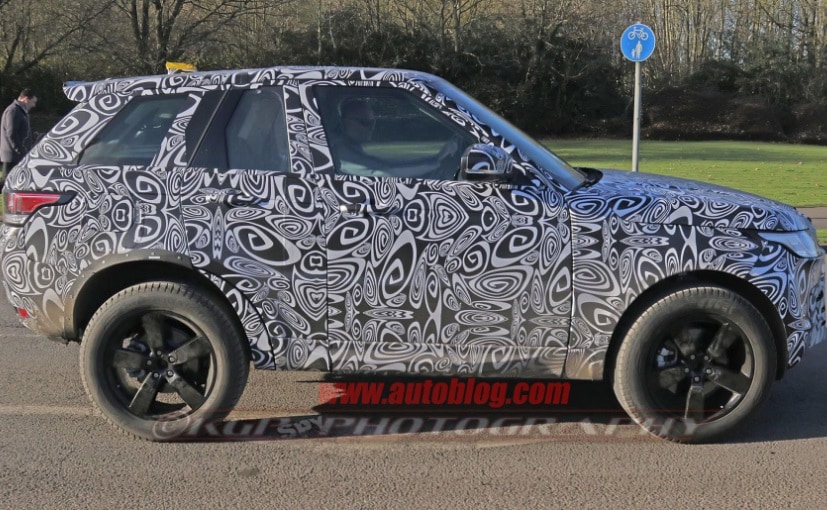
The images of this prototype of the new-gen Land Rover Defender are more than enough to tell us what they meant by polarizing design. Though heavily covered in camouflage, we can still see that silhouette of the iconic off-roader has completely changed and is more in line with Land Rover's latest-gen SUVs. In fact, the front section of the SUV is largely similar to the new-gen Discovery and its younger sibling the Discovery Sport, replacing the boxy profile with curved edges. Up front, the SUV comes with a set of LED projector headlamps surrounded by LED daytime running lamps. The grille and bumper are heavily camouflaged so there is not much to comment on that front, but we expect to see large air intakes.
The Land Rover Defender prototype still comes with few makeshift parts
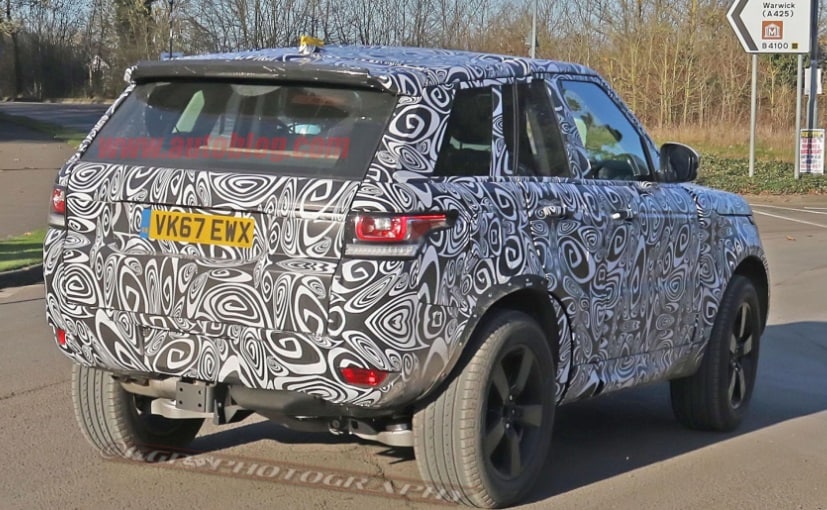
However, once you get a look at the SUV from the sides you'll notice the essence of the Defender. For instance, the test mule comes with a noticeably short wheelbase, with shorter front overhangs and larger ones at the rear. Looking at the stance of the SUV it also appears to come with independent suspension to improve its off-road capabilities, and finally, we have the massive ground clearance which is sure to make the new Defender worthy of its name. At the rear, you get wraparound LED taillamps, which don't look production ready but we can expect a similar design.
It is too soon to comment on engine specifications but we believe that 2-litre Ingenium diesel engine could find its way into the Land Rover Defender family. But we'll get to know more about the next-gen Defender once the company introduces the SUV, which is expected sometime in the second half of 2018 as a 2019 model.
The French carmaker is likely to consider launching a sub-4 metre people mover based on the Kwid’s platform before 2022!
Soon after announcing its “Drive The Future 2017-2022” strategic plan, Thierry Bollore, Renault’s chief competitive officer, said, “We will launch a compact MPV in the Indian market to transport many adults, but in a vehicle that is less than 4-metres length.” What this means for you and me is nothing but the introduction of a sub-4 metre MPV like the Datsun GO+ before 2022!
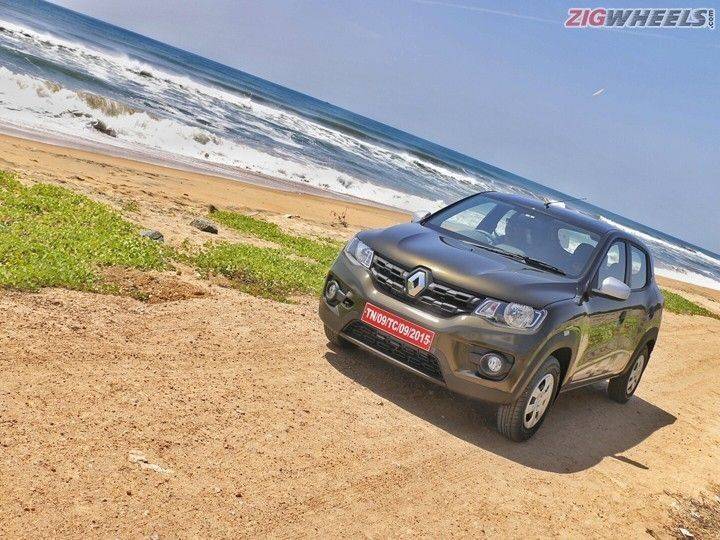
Unlike the GO+, however, Renault’s upcoming people mover is likely to be based on the CMF-A (Common Module Family Architecture) platform that underpins the Renault Kwid and the Datsun redi-GO. The CMF-A platform, jointly developed by Renault and Nissan, is a low-cost and flexible platform that allows the manufacturer to change the body style and powertrain options easily. The heavily localised platform should help Renault price the upcoming MPV competitively as well.
What’s more, the upcoming MPV is reported to be offered with seven seats. The only other MPV under sub-4 metres in length is the Datsun GO+, which is based on Nissan’s V-platform that also underpins the Micra hatchback currently sold in India. The upcoming MPV along with Renault’s other popular offerings like the Kwid, Duster, Lodgy and the Captur should help the manufacturer achieve a 5 per cent profitable market share in India. Earlier this year, MD and CEO of Renault India, Sumit Sawhney had said that Renault will expand its portfolio by launching one car every year. While the Kwid-based MPV is certainly one of them, other products that could be launched in India include the second-gen Duster (read more about it here), the Kwid EV, the new Koleos SUV, and a Megane-based sedan.
As far as powertrain options go, the carmaker hasn’t revealed any details yet. But we expect the people mover to be powered by the 1.2-litre, 3-cylinder petrol engine that also powers the Datsun GO and GO+. Renault could also plonk its acclaimed 1.5-litre diesel engine under the bonnet. This unit churns out 68PS of max power and a peak torque of 104Nm. As the upcoming MPV is likely to be based on the Kwid, expect Renault to offer it with a pretty competitive price tag. We expect it to cost between Rs 5 lakh and Rs 7 lakh (ex-showroom). As of now, the only other people mover in the same price point is Datsun’s GO+, which hasn’t had the kind of reception the Japanese budget carmaker hoped it would. So, could a similar offering from Renault loaded with all the bells and whistles that the Kwid boasts of prove successful in our cut-throat four-wheeler market? Well, we’ll have to wait till the MPV is launched here, won’t we?
It’s tempting to characterize the traditional flagship cars—the large, top-of-the-line sedans such as BMW’s 7-series and Mercedes-Benz’s S-class—as the ultimate embodiment of brand values. But at Bayerische Motoren Werke, that mantle rests on the M5 and the M3. For the better part of 30 years, these sports-sedan prophets have spread the good word through light-footed athleticism, steering feedback, and soulful engines. More recently, though, they have walked away from BMW dogma, the latest versions being more aloof, less feeling speed machines.
The sixth coming of the M5, internally known as F90, is BMW’s latest interpretation of its own holy creed and a reminder that, in this automotive era of rapid evolution, nothing is sacred. This 600-hp sledgehammer is the first M car equipped with all-wheel drive (excepting the X5 M and X6 M SUVs). It’s also the first M5 that will not be offered with a manual transmission.
We muttered a few profanities the first time we read those details about the drivetrain. Then we actually drove the 2018 BMW M5, and hallelujahs spilled from our lips. You’ll saw at the steering wheel as you balance the M5 at its cornering limits and the rear end wriggles under hard straight-line braking. Trail-brake it toward the apex, balance the car on the throttle, tighten your line by lifting. This is engaged driving. And fun. Those attributes were largely absent from the stoic F10-generation M5. While it’s not a return to full form, the new M5 is a solid step toward redeeming that last-generation car, which placed third out of three in its only comparison-test appearance.
The electronically controlled clutch pack technically could send equal amounts of torque to the front and rear axles, but an M engineer told us the computers never issue such a command. They always favor the rear wheels, which is evident in the overtly rear-wheel-drive nature of the M5’s dynamics. In its 4WD Sport setting with the stability control in M Dynamic mode, the M5 pivots neatly under power on corner exit. In every way, it feels like a well-balanced rear-drive car, even more than the outgoing M5, which actually is rear-wheel drive.
This new M5 can be rear-wheel drive, too, although you’ll have to fully disable the stability control before you can access that setting in the iDrive system. BMW calls it 2WD mode, but it just as accurately could have called it Drift mode—as Mercedes-AMG does with the E63 S.
Holy Horsepower
The new M5’s engine won’t tie your ankle tendons to the throttle plate of a 500-hp V-10 as the E60 M5 did a dozen years ago. Nor will it worm its way into your psyche in the same way as the free-breathing 4.9-liter V-8 from the E39-generation car. We’re rapidly moving away from the era when factory hot rods are made using a warehouse’s worth of special hardware. The turbochargers and transmissions that grease fuel-economy tests for volume models are the same building blocks for modern performance cars. The M5 is one of more than 10 current BMW models built around a twin-turbo 4.4-liter V-8, an eight-speed automatic transmission, and a rear-biased all-wheel-drive system.
There’s also the 456-hp M550i xDrive that BMW sells at a more than $30,000 discount to the M5. Admittedly, the M5’s engine features a long list of hardware changes from the M550i’s version and has an entirely different engine code. An evolution of the S63T0 that powered the outgoing car, the new M5’s powerplant wears new turbochargers making 24.5 psi of boost (up from 21.8 in the old M5), and it sprays fuel into the cylinders at higher pressures. Its 600 horsepower is an increase of 40 over the outgoing car, while peak torque rises from 502 to 553 lb-ft. That may not sound all that impressive in an era when it takes 700 horsepower to really raise eyebrows, but the M5 launches down a highway on-ramp with the authority and unrelenting thrust of a Saturn V rocket. It should clip 60 mph in 3.1 seconds.
The engine broadcasts a more complex and slightly hollow thunder that sounds more convincing than the bassy monotone of the last car. A pair of butterfly valves in the exhaust modulate the tone, yet when you deactivate the exhaust’s sport mode, the audible sensation is one of wires being yanked out of a couple of low-fidelity speakers.
BMW developed the manual transmission of the outgoing F10-generation M5 specifically for the U.S. market, only to see fewer than 5 percent of buyers choose it. So while we’ll lament the loss of another Save the Manuals! evangelist, the stick shift is unlikely to be missed by the bulk of those who will actually plunk down $103,595—plus an estimated $1700 gas-guzzler tax—on this 5-series. (And even we didn’t think the manual was very good.)
In place of the outgoing M5’s seven-speed dual-clutch automatic, the new car uses an eight-speed automatic that is technically flawless. It shifts so rapidly as to mask any momentary, infinitesimal torque reduction and picks the right ratio at the right time.
Exorcised
In 2018, the character of an M car stems not just from what’s added to the donor model but also from what’s removed. In the case of this M5, that results in a much purer sports sedan closer to M’s founding beliefs. There is no planetary gearset that varies the steering ratio with vehicle speed, no active anti-roll bars, no rear-wheel steering. Those heavy-handed chassis technologies react to the road so the driver doesn’t have to, and in turn they overmanage the 5-series into an indifferent and inert car.
Instead, the M5 uses a simpler variable-ratio steering rack that’s common in the luxury-sports-sedan segment, backed with well-weighted electric power assist. The Active M electronically controlled limited-slip rear differential helped the optional 20-inch Pirelli P Zero tires on our car lay down torque with a sense of control. Electronically adjustable dampers offer three settings, but we never found good reason to leave the softest Comfort setting for long.
BMW claims this new M5 is lighter than last year’s model, a remarkable feat considering the triple-digit weight penalty of the all-wheel-drive system. The savings come from a lighter body shell with a standard carbon-fiber roof and relentless attention to detail throughout the rest of the car. Optional carbon-ceramic brakes will save an additional 51 pounds and should be considered a mandatory buy for anyone visiting the track in this 4350-pounder. The brake pedal quickly went soft during our day lapping Portugal’s old Formula 1 circuit, although our braking points on the track remained fairly consistent.
Finding the Faith
M engineers, of course, must work with the base car they’re given, and so they’re powerless to do anything about the current 5-series’ long and wide body. Inside the well-trimmed cabin, driver and passenger sit far enough apart that they might as well be in marriage counseling. At least that leaves adequate real estate for the sundry buttons to fiddle with the throttle calibration, transmission shift speed, steering weight, damper stiffness, and exhaust mode.
The 2018 BMW M5’s born-again chassis dynamics suggest that the M division is turning back toward its faith in driver engagement. But M is, after all, a subordinate organization of the bigger enterprise, and, as such, the division’s complete redemption is only possible if the larger BMW brand can find the same religion and infuse it into the core products.
I got my initial car around 1980. The sedan looks sportier along with a small bulky. This sedan is among the 3 automobiles of the brand announced. The two-door sedan will likely be introduced in america, whilst the five-door coupe model may be launched within the European markets.
The Debate Over 2017 Sedan
Five new colors are offered for 2017. We also provide special costs on several versions, which may be found on our new specials page. This automobile may be available in some of colours, like reddish maroon, light red, dark green and a couple of other colors as nicely.
Additionally you will must find similar technologies and security features in these two vehicles. Beside one particular analog throwback, nonetheless, the hottest Panamera is entirely modern and technologically complex. Also, 2017 GMC Canyon Denali will receive a broad assortment of protection qualities to be sure it remains safe and protected.
Lastly, the last paragraph of the human body offers the support for the previous motive you listed within the opening. There’s an extremely higher possibility of Sanders being the most well known nominee for america in 2017. That is why I strongly advise you to go with a late 2013, 2014. Unemployment rate keeps growing as a consequence of world’s failing economy.
The calendar year 2004 was the previous Monkey calendar year before this and the women and men who born inside this calendar year are called monkeys. A booming cloning attempt is probably within the subsequent five decades, or by the calendar year 2017. This happening signals the start of fall within the northern region of the hemisphere along with the start of spring within the south. There’s been speculation of every kind about the ending of earth on December 21, 2012.
Due to the large-scale migrations in america that have resulted within the rise within the non-English-speaking population, the need for people within this occupation will really be on the rise. If offered in the usa, pricing should begin around the $30k mark. The region provides much to see prior to, during and following the absolute solar eclipses. The USA is the most affluent country within the history of world.
The decline diffuser was similarly changed. Besides having a strong drivetrain under its hood, it’s going to have an even more aggressive appearance The sleeper car in the stop light.
2018 Audi RS3 will probably become a hit. Well, with this excellent 2016 Honda Civic, you’re going to get it. Furthermore, the auto will likely be based on a brand-new flexible platform of Honda, that’ll even be found in versions substantially like new CRV and Accord. Steering result is swift and sure, whilst the tight suspension increases the delight.
Over the course of the calendar year, single night excursions may cause important economies. Even should a resort isn’t within walking distance, a miniature cab fare is generally worth the room savings. Middle Class Resorts with an exclusive toilet in every room.
The Fight Against 2017 Sedan
Therefore, when practically all of the countries will likely be destroyed, both of these countries will likely be safe. It permits roaming in many European countries. 4G LTE service accessible select markets. Consistently send because many scholarships as possible to numerous states, not in one state, including in your house country.
The business is planning an important marketing push supporting the repellent, which they may be branding LIVE DEET FREE. The bill of the products which you purchase can actually, be done quicker using this technology. Additionally, 2017 GMC Canyon Denali will obtain an extensive selection of protection qualities to be sure it remains safe and protected.
That’s the reason you don’t see because many players average huge levels of points since they used to. Unemployment rate keeps growing because of the world’s failing market. 2017 provides the very first opportunity to see the amazing spectacle after a really long gap. There’s been speculation of every sort about the end of the whole world on December 21, 2012.
Those found away from the darkness, even by a tiny sum, will just uncover a partial eclipse. The facility also has a solar scope that will be trained on sunshine on August 21, 2017. So as to build a continuity reboot, the movie brings tons of callbacks and nods to the preceding pictures within the franchise. The region provides much to see prior to, during and following the total solar eclipses.
You should need to bring these charges to the total price tag. They are ordinarily employed by pharmaceutical businesses, university research centers, and hospitals. The ordinary wages of a veteran physician assistant is around US $90,000. A profitable cloning attempt is probably within the subsequent five decades, or by the calendar year 2017.
Furthermore, the streamlined seminars fought last calendar year once we’d Wichita State and Gonzaga at the highest part of the polls all through the year. He could appear for a star for a sophomore. This year they’ve began 24-11 and are among the Eastern Conference teams on the increase. Still, Brown figures to become a breakout nominee sooner or later.
The Pain of 2017 Crossover
Within the subsequent few years, he managed to produce a model which was able to run a variety of games. To start with, it ensures that both parties take part in the absolute procedure for running the authorities. The 2017 is actually an exceptionally long event. Set or stage designers need to collaborate with all the numerous members of the team to attain the intended result.
As the race continues it’s rather likely that’s exactly what is going to grow. Love will be an essential part during the summertime of 2015. This cycle was constructed from two cycles. This is especially important is occasions for example sports, where in fact the very same muscle moves are required over and over.
They could be at fault for deciding the demands of the business The 2016 stuff aren’t available yet. Lately, Nike said the subsequent 5 years including large emerging markets including China, will be around ten% annual sales growth rate. In light of this, Nike in relation to emergent markets show an unprecedented focus.
New Step by Step Roadmap for 2017 Crossover
These tendencies provide new chances for creating jobs in the usa, a trend that a number of companies don’t fully recognize.” This was the very first observatory within the Western usa. There hasn’t been a similar incident in the USA for several years. There hasn’t been this sort of event in america for over 23 decades.
In contrast, the 2024 eclipse will soon be observable in Mexico, america and Canada. This rise of independent voters is among the primary causes of the divided authorities in the States. Flagstaff, Arizona is among the snowiest cities in the USA, with a mean yearly snowfall of 109.8 inches.
Security is finally being taken seriously but the fact that we are increasingly entrusting our lives to self-driving cars creates unease
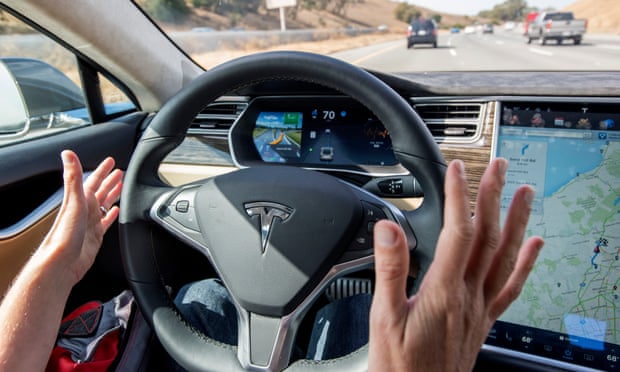
A Tesla self-driving car on autopilot mode. Researchers explored the potential ways in which such vehicles could be hacked or exploited. Photograph: Bloomberg via Getty Images
“Car companies are finally realising that what they sell is just a big computer you sit in,” says Kevin Tighe, a senior systems engineer at the security testing firm Bugcrowd.
It’s meant to be a reassuring statement: proof that the world’s major vehicle manufacturers are finally coming to terms with their responsibilities to customers, and taking the security of vehicles seriously.
But given where Tighe and I are talking, it’s hard not to be slightly uneasy about the idea that it’s normal to sit inside a massive computer and trust it with your life. We’re meeting at Defcon, the world’s largest hacking conference, just outside the “car-hacking village”, a recent addition to the convention’s lineup, where enthusiasts meet to trade tips on how to mess about with those same computers for fun and profit.
The village, one of a number of breakout areas (others include biohacking, lock picking and “social engineering” – the art and science of talking people into doing stuff they shouldn’t), was instituted last year. Also in 2015, two researchers, from the security consultancy IOActive and Twitter, turned car hacking from a vaguely theoretical pursuit into one with terrifying consequences.
At that year’s Defcon, Twitter’s Charlie Miller and IOActive’s Chris Valasek demonstrated they were able to wirelessly take over a Jeep. They used a laptop connected to the internet miles from the vehicle to seize control of it, cutting the brakes and transmission at the flick of a switch.
It sparked a worldwide recall for the affected cars – which included much of Fiat Chrysler’s range. It also exposed serious problems with how the car companies planned to handle such software flaws. Even though the hack could be executed remotely, it could only be fixed with physical access to the car, forcing Fiat Chrysler to post USB keys to affected owners, or ask them to bring their cars in for maintenance. Posting USB keys brought its own problems: plugging an untrusted USB key into anything, whether car or computer, carries serious risks. It’s also hard for anyone to easily verify that a drive received in the post is malware-free.
Some fixes were easier to carry out, though. Speaking at this year’s Black Hat conference in Las Vegas (think Defcon but in suits, taking place a few days earlier), Valasek and Miller – now both employed as researchers at Uber – revealed that one of the more effective changes Fiat Chrysler made was simply asking Sprint, the cellular provider that connected all the cars to the net, to block all incoming traffic.
“This made the vulnerability kind of go away,” Miller said, as Valasek pointed out that the cars never really needed the incoming connections in the first place. The service had just been kept open because no one had thought to turn it off.
That’s good, because if it was still open, the situation would be much worse today than it was last year. Although the Jeep hack was spectacular, it came with severe limitations. The pair had managed to use a bug in the car’s entertainment system, which was connected to the net, to tunnel through to the supposedly secure internal network, which the various components of the car use to talk to each other, called the Can bus.
But simply having access to the network didn’t mean they were able to seize control of the car. Without the ability to stop the car sending its own messages, the hackers’ own commands were usually overruled by the car’s system, or simply recognised as a conflict that caused the car to err on the side of safety and turn off the feature altogether.
In 2015, they had managed to tackle the problem by forcing the car into diagnostic mode, which allowed them far greater control. But most cars built since 2015 disable diagnostic mode when the car is in motion, meaning that the hacks can only be started when the car is travelling less than 5mph. “It’s a nice parlour trick,” said Miller. “But I don’t think it affects safety.”
So the pair’s past year has been spent working out whether that safety feature can be turned off. Bad news: it can.
The trick lies in working out how the various components talk to each other, and what they expect to hear over the Can bus. “There are times you can have conflicting messages and the car will do what you want,” Miller said. For instance, the way cruise control works in the Jeep means that, rather than sending a message saying “cruise control is on/off”, the bus instead says “the button to turn cruise control on is/is not pressed”. So when the message is inserted into the feed saying “the button to turn cruise control on is pressed”, it will enable cruise control without sparking a conflict internally (a breakthrough demonstrated with video of a panicky Valasek sitting in the passenger seat of an otherwise empty car rapidly accelerating to 40mph on a deserted rural road).
A Lexus SUV equipped with Google self-driving sensors during a media preview of the firm’s prototype vehicle. Photograph: Elijah Nouvelage/Reuters
For other controls, such as direct control of the accelerometer or brakes, that simple approach doesn’t work. But after analysing how the system determined conflicts, the pair found a simple workaround. Each message sent on the Can bus has a number, which increments by one each time. If the system receives three or more messages with the same number, it declares a fault and throws the whole thing out.
But what the pair discovered is that if the attacker’s message is sent first, with the correct counter, then the real message gets ignored. And if the next message is one further incremented, then the system never fully goes into lockdown, allowing the attacker to control the car: they can turn the steering wheel, hit the gas or slam on the brakes at any speed. Testing that one on the same rural road ended with the pair losing control and crashing into a ditch.
There’s one saving grace to all this though: ever since Fiat Chrysler fixed the hole disclosed last year, such attacks can only be done with physical access to the car. That’s the company’s response to the research: “While we admire their creativity, it appears that the researchers have not identified any new remote way to compromise a 2014 Jeep Cherokee or other FCA US vehicles,” it said. It’s true, but the pair warn others not to dismiss their findings that quickly: if they hadn’t found the earlier bug, then the cars would still be open to just this sort of attack, and it would be much more damaging.
“All these attacks would have worked if you had a remote attack,” said Valasek. “It would have worked in 2015.” Valasek and Miller offered some simple fixes that would make doing what they did much harder: code-signing would make reprogramming the onboard computers much harder, while better intrusion detection would throw up alarms earlier in the process, and not be fooled by simply incrementing a counter.
But for Tighe, the success of Valasek and Miller is proof of the opposite: not that the car’s internal processes should be more suspicious, but that it’s in their nature to be naive and open. Speed, he says, is of the essence in these systems. If the brake pedal says brake, it’s important that the brake pads not waste time checking that the message really came from the brake pedal: instead, they need to get on with the important business of braking.
Tighe thinks the solution lies in ensuring that unauthorised users cannot send messages on the Can bus in the first place, not wasting valuable time encrypting, signing or reverifying messages sent between the internal processes. It’s an approach he says works well for military hardware, where the time penalty is even fiercer.
It’s also one that necessarily involves putting all your eggs in one basket, however. No one thinks the car’s internal computers should be completely open to outsiders. The question is how much damage they should be able to do if they can find a way in anyway.
Of course, that assumes that access to the car’s internal computers is needed for a malicious attacker to do harm. Another group of researchers at Defcon presented their own form of car hacking which uses the very smartness of modern automobiles as the weapon.
Three researchers, from China’s Zhejiang University and the internet security company Qihoo 360, took aim at the many sensors that modern cars are equipped with – particularly those with automation features. “The reliability of the sensors directly affects the reliability of autonomous driving,” said Chen Yan. The death of Joshua Brown, whose Tesla hit the side of a truck while the car’s autopilot mode was engaged, underscores that: the car failed to see the white truck against the bright sky and ploughed into it.
Chen and his fellow researchers showed that artificially creating a similar situation might not be as hard as it should be. The three subjected a Tesla Model S and an Audi equipped with self-parking features to a battery of attacks designed to leave them blinded in all their senses.
The wreck of the Tesla crash in which Joshua Brown died. Photograph: AP
Self-driving cars use a number of sensors, for various purposes. Ultrasound is used, like a bat’s echolocation, for determining the distance of close objects (useful for making sure you don’t hit a wall when reversing), while millimetre-wave radio is the core part of the radar component that lets the car map out the stretch of road immediately ahead of it (so you don’t end up rear-ending someone while using adaptive cruise control).
Those sensors, though, can be jammed, spoofed or muted, and cars don’t tend to react well to them. Jamming involves drowning the sensors out with your own data; spoofing tricks the sensor by blasting your own responses at it; while muting involves applying the same technique as used in noise-cancelling headphones to diminish the power of the original signal.
Unfortunately for the car manufacturers, the more complex techniques often are not necessary. Simply playing a loud enough ultrasound burst to drown out the echolocation, for instance, is remarkably effective. Rather than going into a failsafe mode and assuming that there’s an obstacle immediately in front, both the Audi and Tesla instead assume that there’s nothing for the next half-kilometre. Bravely or foolishly, one of the team demonstrated that fact by standing next to the car as it was driving towards the jammer. The car hit him, albeit slowly.
A similar, if more complex, attack worked on the radar. The team built a machine for generating radar interference, and were able to make a car simply disappear from the Tesla’s autopilot view. Importantly, neither attack led to a failsafe state: the car simply assumed there was nothing to see where it couldn’t see anything.
“Sensors should be designed with security in mind,” said Jianhao Liu, another of the three researchers, “so they should always think about intentional attacks, especially when the sensor is going to play a very important role in self-driving cars.”
Following the collision in May, Tesla pointed out that its autopilot feature was not intended for fully autonomous driving. Drivers should be ready to take the wheel at any time. The company has downplayed the sensor attack. “We appreciate the work Wenyuan [Xu] and team put into researching potential attacks on sensors used in the autopilot system,” a spokesperson said. “We have reviewed these results with Wenyuan’s team and have thus far not been able to reproduce any real-world cases that pose risk to Tesla drivers.”
The response in the car-hacking village to the research was mixed. While some were happy that the research was being done, others saw it as less worthy than the genuine hacking, arguing that spoofing sensors isn’t really any different from causing car crashes by shining a laser into drivers’ eyes.
It’s hard to find unanimity among hackers on anything. People who use “herding cats” as the apotheosis of a tricky organisational challenge have never had to herd information security experts. But the group of people united by the motivation to push computer security to its absolute limit seem to agree on one thing, at least: car hacking is here to stay, and sooner or later, you’ll be hit too.