Showing posts with label BMW. Show all posts

Wednesday, 6 December 2017

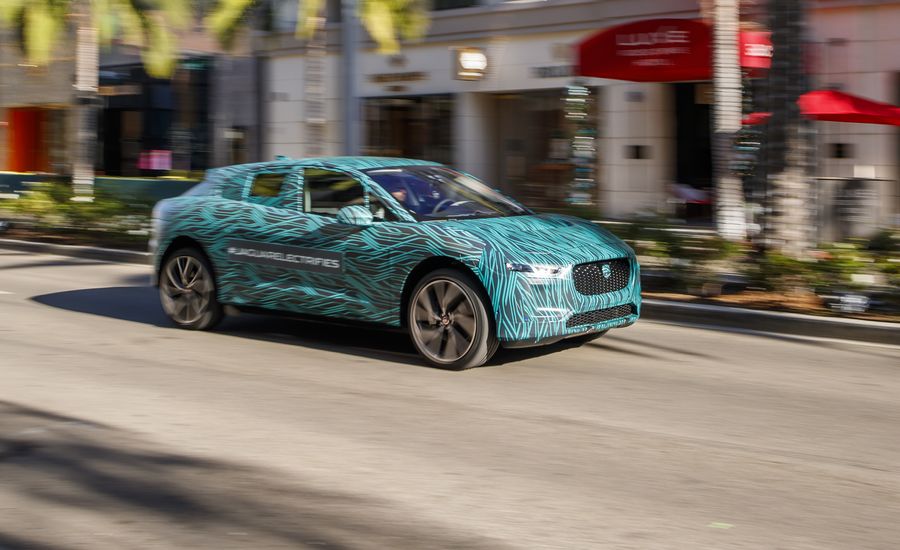
2019 Jaguar I-Pace


The I-Pace is Jaguar’s first electric vehicle, and although it’s still months away from showrooms, we got a ride in a preproduction prototype built using the final tooling. Jaguar isn’t doing the final assembly for the I-Pace; instead, Magna Steyr, the contract builders of the Mercedes-Benz G-class and the BMW 5-series, will screw them together in Graz, Austria. Despite not driving the Jag ourselves—that will come later—we did learn a bit more about the I-Pace even as company executives remain largely tight lipped regarding final specs, how much it will cost, how quickly it will charge, and whether Jaguar will be making any infrastructure investments like Tesla.
The I-Pace will go on sale late next summer in Europe and should arrive in the United States in the fall. Most of the stats that Jaguar would discuss were lifted directly from the concept version shown a year ago. A range of more than 200 miles is promised, made possible by a 90.0-kWh battery pack that uses pouch-type lithium-ion cells. Jaguar is employing an outside supplier for its batteries; we’re guessing it’s Panasonic, given the Panasonic/Jaguar partnership in the Formula E electric racing series. In contrast, the two identical electric motors that move the I-Pace were designed in-house. One is located up front and the other at the rear, each independently driving an axle; together they provide all-wheel drive and a default 50/50 front-to-rear torque split that can be altered to adapt to slippery conditions. The motors also can perform this trick in the interest of efficiency. Each motor is good for 200 horsepower and 258 lb-ft of torque, for totals of 400 horses and 516 lb-ft.
VIEW 28 PHOTOS
Despite the camouflage wrap concealing the look of the crossover’s aluminum body, we could see that the I-Pace has an interesting vent in the hood that allows air to pass over the exit of the radiators and help extract heat while, according to Jaguar, improving aerodynamics—a 0.29 drag coefficient is claimed. If you’re wondering why an EV has a radiator at all, the answer is that an EV’s battery needs to be cooled to remain in its optimal operating-temperature range, as they can generate a lot of heat when they’re being charged or quickly discharged. In this case, Jaguar’s solution is liquid cooling via coolant, a radiator, and a circulating pump.
From the passenger seat, the I-Pace experience is pretty typical of most electric cars. There’s a largely hushed whirring from the motors—in the prototype this sound became particularly loud when the I-Pace was decelerating and recharging its battery via regenerative braking, although Jaguar tells us that the production version may be quieter. Speaking of regenerative braking, two selectable modes are available. The first is more conventional, meaning you need to use the brake pedal more often, while the second is more aggressive and allows you to drive using only the accelerator. Lifting off the throttle provides enough braking force to slow the vehicle without having to apply the four-wheel disc brakes. The ride from the air-spring-equipped I-Pace we rode in was supple despite the large 22-inch wheels wrapped in 255/40 Pirelli P Zero tires.

Acceleration is quick and, as in a Tesla Model S, the power hits right away. Jaguar claimed a zero-to-60-mph time of 4.0 seconds when the concept was unveiled, and we have no reason to doubt that time. Inside, the seats are comfortable and there’s a decent amount of rear-seat space—about what you might find in Jaguar’s mid-size F-Pace crossover. Large pieces of cloth camouflage were draped over the interior, but we could see a touchscreen that appears to be shared with the rest of the Jaguar lineup.

Oh, and why is this vehicle called the I-Pace, when E-Pace—the name Jaguar is using for its new, conventionally powered compact SUV—seems to make more sense? The reason is that Jag’s Formula E race car is called the I-type, so the brand’s electric vehicles will get the letter I instead of the letter E. We still think E-Pace would be a better fit, but with that burning question answered, we now must wait until the I-Pace officially debuts in March to see the final styling and learn the rest of the details.
source: caranddriver.com

2019 Ram 1500: Nearly Shorn Light-Duty Pickup Spied!

Moving out of the crosshairs and away from the nostrils.


What It Is: Clad in minimal camo, the next Ram 1500 has been spotted with its new grille largely on display for all to see. The revised unit is hexagonal and perhaps a mite Audi-esque, not quite as dominant a piece as the big-rig maws that Fiat Chrysler Automobiles’ trucks have been wearing since before Daimler’s merger of equals with the Pentastar, back when they were badged Dodge. A pair of subtler, rectangular intakes replaces the overly styled nostrils on recent Rams, while the headlights, with their light-bar DRLs, seem to crib inspiration from the Dodge Durango and the Chrysler 300. Out back, the taillights add complexity and surfacing while also hinting at the 1970s through ’90s D-series pickups’ rear lighting modules.
Why It Matters: The light-duty 1500 is the anchor of the Ram line and the basis for everything from workaday landscaping vehicles to full-custom lifestyle statements. It serves as the basis for the sporty, off-road-oriented Rebel and could underpin a future Ford Raptor–fighting version of said machine, a potential move that has the micturating-Calvin-decal aftermarket wetting its pants with anticipation.
VIEW 31 PHOTOS
Platform: It’s an American pickup. There’s a ladder frame underneath. Because it’s a Ram 1500, expect coil springs all around, with available air springs. Ram isn’t following Ford—or even its siblings at Jeep—all the way into the future, though, as the 1500 will retain a steel body. We do expect the cab to grow, and we’ve already seen camouflaged Mega Cab models running around. Another feature rumored for the new Ram is a split-opening tailgate, which could drop down as a single-piece unit or open in two sections, barn-doors-style. That design is not seen on the truck in these photos but is likely to be an option.
VIEW 31 PHOTOS
Powertrain: The engine room also could see some new choices. There’s talk of a turbocharged inline-four, possibly as part of a hybrid powertrain, as has been announced for the new Jeep Wrangler. FCA being FCA, expect the Ram 1500 to retain the Hemi V-8, perhaps in some outlandish capacities. The Pentastar V-6 again will be in the mix as well. Naturally, both four-by-two and four-by-four variants will be available.
Estimated Arrival and Price: We’ll know more when the truck is unveiled early next year, most likely at the Detroit auto show. As for pricing? The new trucks should start right around $29,000 and go up from there, depending on powertrain, cab size, and degree of luxury.
source: caranddriver.com

Next-Gen Land Rover Defender Caught Testing

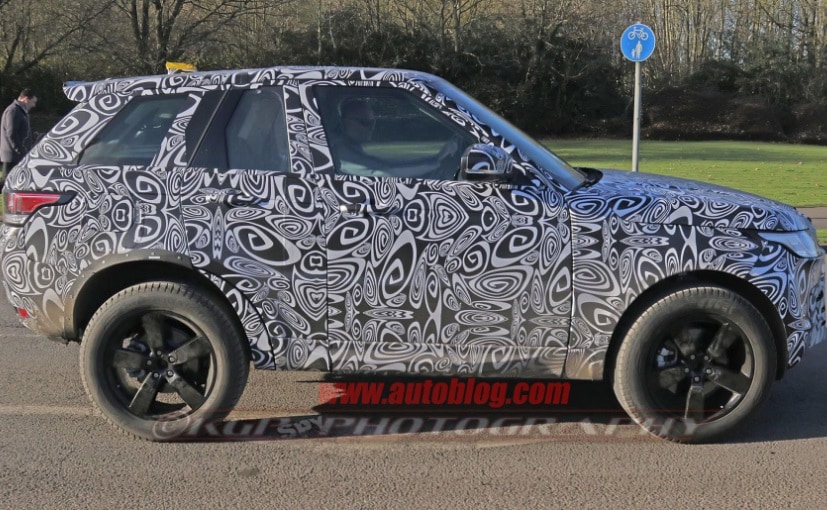
The next-gen Land Rover Defender will come with a completely new design language and styling, in line with the company's current line-up of SUVs. We expect Land Rover to introduce the SUV in 2018.


The Land Rover Defender is unarguably one of the most iconic SUVs to come out the British manufacturer's stable. Jaguar Land Rover (JLR) officially pulled the plug on the legendary off-roader almost two years back, in January 2016 after thirty-two years of production, due to stringent emission norms and falling demand. Thankfully, the Tata Motors-owned luxury carmaker was rumoured to be working on the next-gen Defender and its arrival at the LA Auto Show 2017, saying that the next one will come with a 'polarizing' design. Now, just a few days later, we get to see the first images of the next-gen Land Rover Defender's test mule.
land rover defender side
The new Land Rover Defender will continue to carry its tall off-roader stance
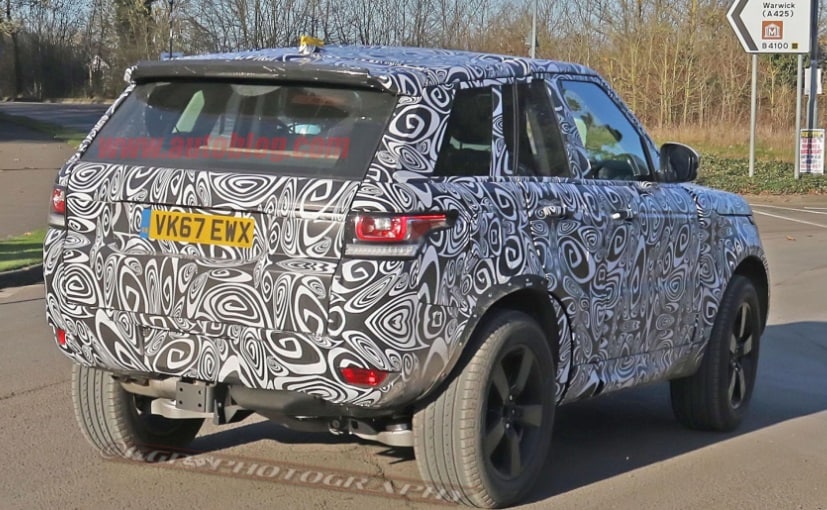
The images of this prototype of the new-gen Land Rover Defender are more than enough to tell us what they meant by polarizing design. Though heavily covered in camouflage, we can still see that silhouette of the iconic off-roader has completely changed and is more in line with Land Rover's latest-gen SUVs. In fact, the front section of the SUV is largely similar to the new-gen Discovery and its younger sibling the Discovery Sport, replacing the boxy profile with curved edges. Up front, the SUV comes with a set of LED projector headlamps surrounded by LED daytime running lamps. The grille and bumper are heavily camouflaged so there is not much to comment on that front, but we expect to see large air intakes.

land rover defender rear
The Land Rover Defender prototype still comes with few makeshift parts
However, once you get a look at the SUV from the sides you'll notice the essence of the Defender. For instance, the test mule comes with a noticeably short wheelbase, with shorter front overhangs and larger ones at the rear. Looking at the stance of the SUV it also appears to come with independent suspension to improve its off-road capabilities, and finally, we have the massive ground clearance which is sure to make the new Defender worthy of its name. At the rear, you get wraparound LED taillamps, which don't look production ready but we can expect a similar design.

It is too soon to comment on engine specifications but we believe that 2-litre Ingenium diesel engine could find its way into the Land Rover Defender family. But we'll get to know more about the next-gen Defender once the company introduces the SUV, which is expected sometime in the second half of 2018 as a 2019 model.
source: auto.ndtv.com

Renault Reportedly Working On Kwid-Based Compact MPV


The French carmaker is likely to consider launching a sub-4 metre people mover based on the Kwid’s platform before 2022!


Soon after announcing its “Drive The Future 2017-2022” strategic plan, Thierry Bollore, Renault’s chief competitive officer, said, “We will launch a compact MPV in the Indian market to transport many adults, but in a vehicle that is less than 4-metres length.” What this means for you and me is nothing but the introduction of a sub-4 metre MPV like the Datsun GO+ before 2022!
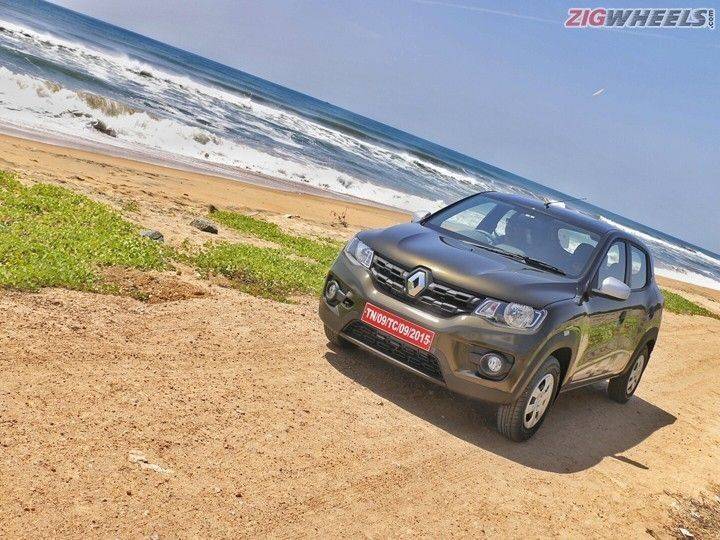
Unlike the GO+, however, Renault’s upcoming people mover is likely to be based on the CMF-A (Common Module Family Architecture) platform that underpins the Renault Kwid and the Datsun redi-GO. The CMF-A platform, jointly developed by Renault and Nissan, is a low-cost and flexible platform that allows the manufacturer to change the body style and powertrain options easily. The heavily localised platform should help Renault price the upcoming MPV competitively as well.
What’s more, the upcoming MPV is reported to be offered with seven seats. The only other MPV under sub-4 metres in length is the Datsun GO+, which is based on Nissan’s V-platform that also underpins the Micra hatchback currently sold in India. The upcoming MPV along with Renault’s other popular offerings like the Kwid, Duster, Lodgy and the Captur should help the manufacturer achieve a 5 per cent profitable market share in India. Earlier this year, MD and CEO of Renault India, Sumit Sawhney had said that Renault will expand its portfolio by launching one car every year. While the Kwid-based MPV is certainly one of them, other products that could be launched in India include the second-gen Duster (read more about it here), the Kwid EV, the new Koleos SUV, and a Megane-based sedan.
As far as powertrain options go, the carmaker hasn’t revealed any details yet. But we expect the people mover to be powered by the 1.2-litre, 3-cylinder petrol engine that also powers the Datsun GO and GO+. Renault could also plonk its acclaimed 1.5-litre diesel engine under the bonnet. This unit churns out 68PS of max power and a peak torque of 104Nm. As the upcoming MPV is likely to be based on the Kwid, expect Renault to offer it with a pretty competitive price tag. We expect it to cost between Rs 5 lakh and Rs 7 lakh (ex-showroom). As of now, the only other people mover in the same price point is Datsun’s GO+, which hasn’t had the kind of reception the Japanese budget carmaker hoped it would. So, could a similar offering from Renault loaded with all the bells and whistles that the Kwid boasts of prove successful in our cut-throat four-wheeler market? Well, we’ll have to wait till the MPV is launched here, won’t we?


source: zigwheels.com

Exclusive: Lamborghini Urus To Launch In India Within Just 38 Days Of Global Debut


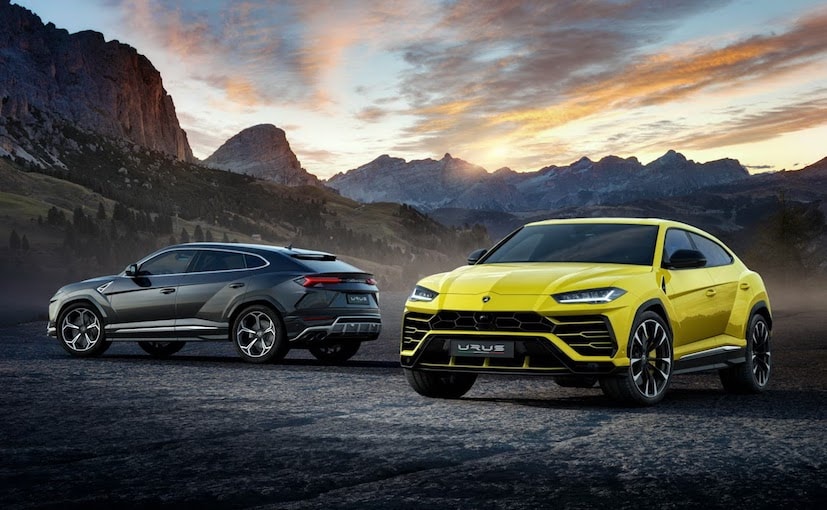
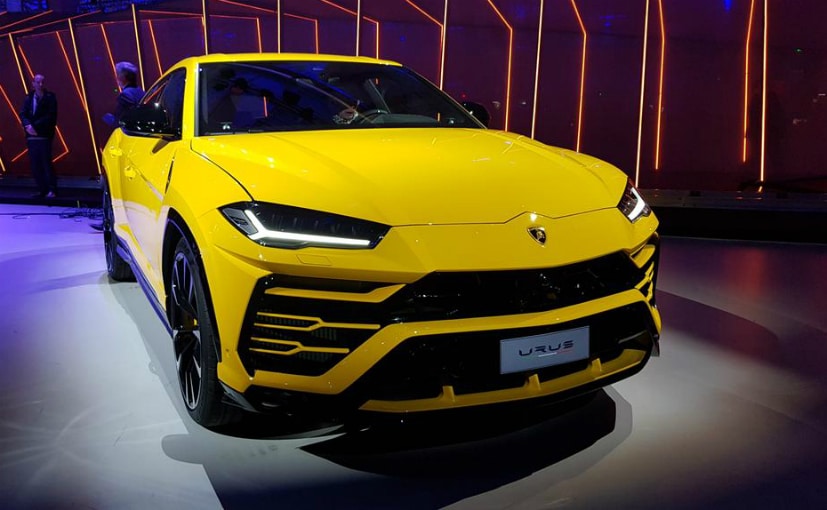
The Lamborghini Urus will likely be a huge game changer for not just the Italian sports car maker itself but the entire luxury and premium set. The Urus straddles the worlds of the SUV, the coupé-crossover, the sports car and the luxury car. It is not going to be cheap to buy, and yet is expected to be sold out even before its launch in most markets. India is one of them, where Lamborghini sources say the buyers for the first allocation of units for 2018 are already stitched up. The Urus will launch in India on January 11 2018 in Mumbai. That is just 38 days after its global debut - and a launch this quick in India almost unheard of in any market segment. Well having said that we also got the Huracan Performante in India just days after its world debut in Geneva earlier this year. And like that car the Urus will be available to buyers to book, even before the official rollout of this model and indeed its first media or customer test-drives.
lamborghini urus
(The Lamborghini Urus can hit 0-100 kmph in just 3.6 seconds and has a top speed of 305 kmph)
The Italian specialist debuted the Urus at its headquarter in Sant'Agata Bolognese in a glittering ceremony graced by the Italian Prime Minister Paolo Gentiloni. Lamborghini also opened a new plant that will make the Urus, and will help it to double its output overall. The Urus is expected to be a huge volumes driver for Lamborghini, which currently sells just 3500 cars a year. With the Urus sales are expected to breach 7000 units a year, and markets like India which love SUVs but cringe away from low-slung sports cars are perfectly suited to it. This is why India is on that first list, with the launch here scheduled to be ahead of possibly even China, Japan and South East Asia.

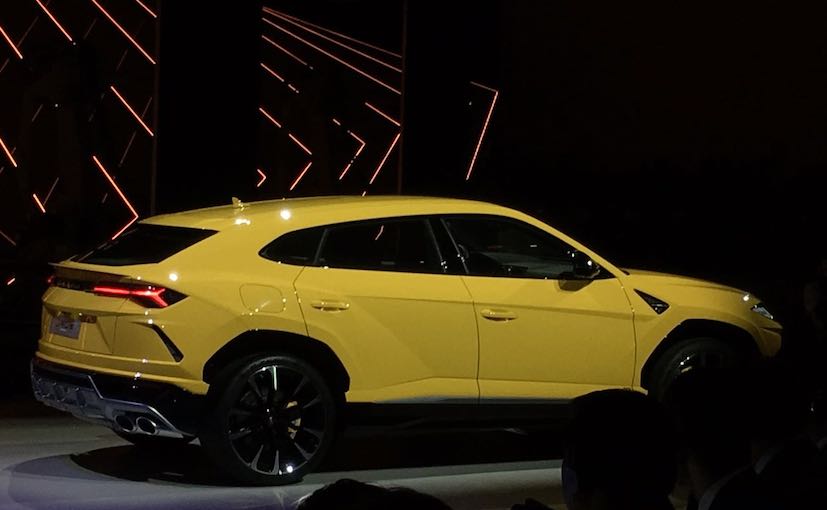
lamborghini urus
(Power on the Urus SUV comes from the 4-litre V8 twin-turbo engine with 637 bhp on offer)
When Porsche brought the Cayenne out, it too was an instant hit with the well heeled in India - even as its 911, Boxster and Cayman failed to fire much in terms of sales. With the Urus Lamborghini will likely experience something similar. The only issue if at all there is one - will be the challenge to meet the demand that the Urus will no doubt generate when it arrives. India will not get a massive allocation in the first 2 years, though it will be much larger than what other Lamborghini models have had so far. The Urus has a 4-litre V8 twin-turbo engine delivering 637 bhp and 850 Nm of torque. It can accelerate from 0-100 kmph in 3.6 seconds and has a top speed 305 kmph. Its 4WD system gets active torque vectoring and four-wheel steering.

source: auto.ndtv.com

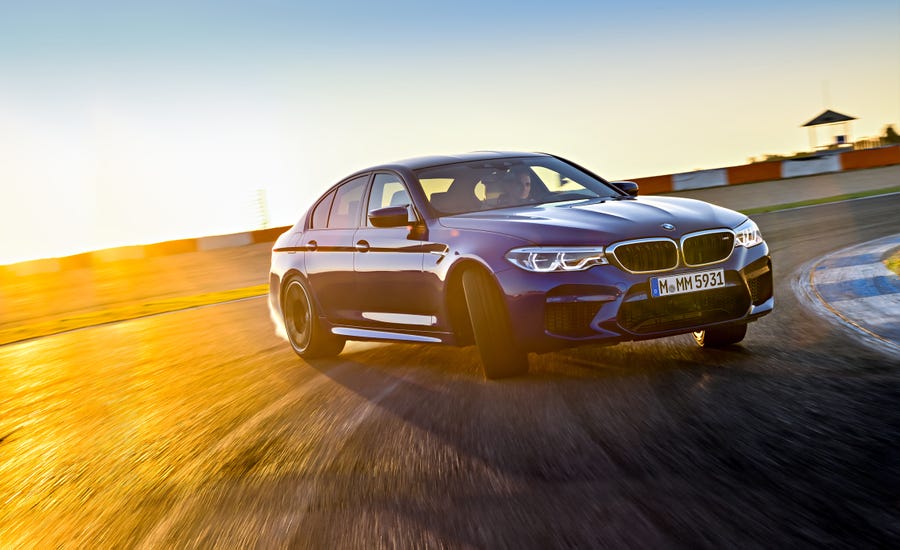
2018 BMW M5

The M5 corners again!

2018 BMW M5


It’s tempting to characterize the traditional flagship cars—the large, top-of-the-line sedans such as BMW’s 7-series and Mercedes-Benz’s S-class—as the ultimate embodiment of brand values. But at Bayerische Motoren Werke, that mantle rests on the M5 and the M3. For the better part of 30 years, these sports-sedan prophets have spread the good word through light-footed athleticism, steering feedback, and soulful engines. More recently, though, they have walked away from BMW dogma, the latest versions being more aloof, less feeling speed machines.
The sixth coming of the M5, internally known as F90, is BMW’s latest interpretation of its own holy creed and a reminder that, in this automotive era of rapid evolution, nothing is sacred. This 600-hp sledgehammer is the first M car equipped with all-wheel drive (excepting the X5 M and X6 M SUVs). It’s also the first M5 that will not be offered with a manual transmission.
We muttered a few profanities the first time we read those details about the drivetrain. Then we actually drove the 2018 BMW M5, and hallelujahs spilled from our lips. You’ll saw at the steering wheel as you balance the M5 at its cornering limits and the rear end wriggles under hard straight-line braking. Trail-brake it toward the apex, balance the car on the throttle, tighten your line by lifting. This is engaged driving. And fun. Those attributes were largely absent from the stoic F10-generation M5. While it’s not a return to full form, the new M5 is a solid step toward redeeming that last-generation car, which placed third out of three in its only comparison-test appearance.
The electronically controlled clutch pack technically could send equal amounts of torque to the front and rear axles, but an M engineer told us the computers never issue such a command. They always favor the rear wheels, which is evident in the overtly rear-wheel-drive nature of the M5’s dynamics. In its 4WD Sport setting with the stability control in M Dynamic mode, the M5 pivots neatly under power on corner exit. In every way, it feels like a well-balanced rear-drive car, even more than the outgoing M5, which actually is rear-wheel drive.
This new M5 can be rear-wheel drive, too, although you’ll have to fully disable the stability control before you can access that setting in the iDrive system. BMW calls it 2WD mode, but it just as accurately could have called it Drift mode—as Mercedes-AMG does with the E63 S.

Holy Horsepower

The new M5’s engine won’t tie your ankle tendons to the throttle plate of a 500-hp V-10 as the E60 M5 did a dozen years ago. Nor will it worm its way into your psyche in the same way as the free-breathing 4.9-liter V-8 from the E39-generation car. We’re rapidly moving away from the era when factory hot rods are made using a warehouse’s worth of special hardware. The turbochargers and transmissions that grease fuel-economy tests for volume models are the same building blocks for modern performance cars. The M5 is one of more than 10 current BMW models built around a twin-turbo 4.4-liter V-8, an eight-speed automatic transmission, and a rear-biased all-wheel-drive system.
There’s also the 456-hp M550i xDrive that BMW sells at a more than $30,000 discount to the M5. Admittedly, the M5’s engine features a long list of hardware changes from the M550i’s version and has an entirely different engine code. An evolution of the S63T0 that powered the outgoing car, the new M5’s powerplant wears new turbochargers making 24.5 psi of boost (up from 21.8 in the old M5), and it sprays fuel into the cylinders at higher pressures. Its 600 horsepower is an increase of 40 over the outgoing car, while peak torque rises from 502 to 553 lb-ft. That may not sound all that impressive in an era when it takes 700 horsepower to really raise eyebrows, but the M5 launches down a highway on-ramp with the authority and unrelenting thrust of a Saturn V rocket. It should clip 60 mph in 3.1 seconds.
The engine broadcasts a more complex and slightly hollow thunder that sounds more convincing than the bassy monotone of the last car. A pair of butterfly valves in the exhaust modulate the tone, yet when you deactivate the exhaust’s sport mode, the audible sensation is one of wires being yanked out of a couple of low-fidelity speakers.
BMW developed the manual transmission of the outgoing F10-generation M5 specifically for the U.S. market, only to see fewer than 5 percent of buyers choose it. So while we’ll lament the loss of another Save the Manuals! evangelist, the stick shift is unlikely to be missed by the bulk of those who will actually plunk down $103,595—plus an estimated $1700 gas-guzzler tax—on this 5-series. (And even we didn’t think the manual was very good.)
In place of the outgoing M5’s seven-speed dual-clutch automatic, the new car uses an eight-speed automatic that is technically flawless. It shifts so rapidly as to mask any momentary, infinitesimal torque reduction and picks the right ratio at the right time.

Exorcised

In 2018, the character of an M car stems not just from what’s added to the donor model but also from what’s removed. In the case of this M5, that results in a much purer sports sedan closer to M’s founding beliefs. There is no planetary gearset that varies the steering ratio with vehicle speed, no active anti-roll bars, no rear-wheel steering. Those heavy-handed chassis technologies react to the road so the driver doesn’t have to, and in turn they overmanage the 5-series into an indifferent and inert car.
Instead, the M5 uses a simpler variable-ratio steering rack that’s common in the luxury-sports-sedan segment, backed with well-weighted electric power assist. The Active M electronically controlled limited-slip rear differential helped the optional 20-inch Pirelli P Zero tires on our car lay down torque with a sense of control. Electronically adjustable dampers offer three settings, but we never found good reason to leave the softest Comfort setting for long.
BMW claims this new M5 is lighter than last year’s model, a remarkable feat considering the triple-digit weight penalty of the all-wheel-drive system. The savings come from a lighter body shell with a standard carbon-fiber roof and relentless attention to detail throughout the rest of the car. Optional carbon-ceramic brakes will save an additional 51 pounds and should be considered a mandatory buy for anyone visiting the track in this 4350-pounder. The brake pedal quickly went soft during our day lapping Portugal’s old Formula 1 circuit, although our braking points on the track remained fairly consistent.

Finding the Faith

M engineers, of course, must work with the base car they’re given, and so they’re powerless to do anything about the current 5-series’ long and wide body. Inside the well-trimmed cabin, driver and passenger sit far enough apart that they might as well be in marriage counseling. At least that leaves adequate real estate for the sundry buttons to fiddle with the throttle calibration, transmission shift speed, steering weight, damper stiffness, and exhaust mode.
The 2018 BMW M5’s born-again chassis dynamics suggest that the M division is turning back toward its faith in driver engagement. But M is, after all, a subordinate organization of the bigger enterprise, and, as such, the division’s complete redemption is only possible if the larger BMW brand can find the same religion and infuse it into the core products.

source: caranddriver.com

Thursday, 3 September 2015

BMW To Hit The World In Frankfurt With Its Superb BMW 330e and 225xe hybrids


BMW will greet the world in Germany Frankfurt Motor Show with models sporting more battery power than ever before, the BMW 330e and 225xe hybrids. Lets see what they got.

Joining the ever-growing electrified line-up at BMW will be a plug-in hybrid version of the 3 Series, dubbed the 330e, and an all-wheel drive plug-in hybrid version of the 2 Series Active Tourer. While the 330e remains a dedicated rear-wheel drive, four-door saloon, the 225xe will not just be a stand-alone model, but it will preview one of the key powertrains planned for the X1 and for the upcoming X2.
Click Here To Read more »

Tuesday, 25 August 2015

What Is The Luxury Car With The Best performance?


This test was carried out by Cars.com. The main goal was to test contenders against each other — on the street and on the track — and find out which is the best luxury performance coupe . The contenders are
  • 2015 BMW M4
  • 2016 Cadillac ATS-V
  • 2015 Lexus RC F
The BMW is an established contender known for its outstanding performance, but the other two are new. Of the three which is the best luxury performance coupe? Lets see the contest.
Click Here To Read more »

Friday, 21 August 2015

BMW i3 Review - One Of 2015 Best Electric Cars On Sales


The world of automobile is going electric in an effort to preserve our green home. So lets take some time off the conventional fuel engines and talk about electric powered cars. If there shoild ever be a list of electric car to buy in 2015 then BMW i3. Lets see the facts BMW i3 - one of the best electric cars for 2015
Click Here To Read more »

Tuesday, 24 June 2014

Checkout The Latest BMW Technology - Your Car Just Got Smarter Than Ever


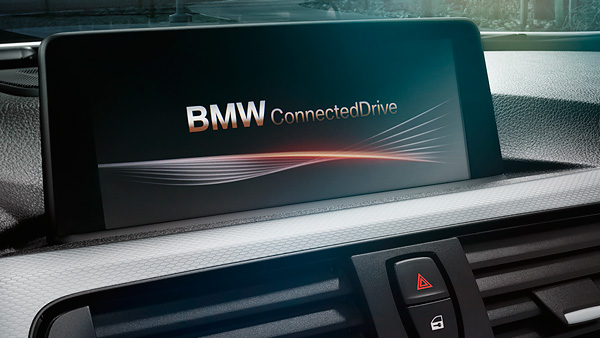
German car manufacturer BMW has upped the stakes in the world of in-car connectivity with its latest ConnectedDrive technology, which allows cars to link up with the driver's office, download traffic information, read e-mails, report accidents and even arrange a car service.

The technology will arrive in SA in July. BMWs built from that month onwards will carry implanted SIM cards that will allow owners to register online for the various services. Some will be available immediately and others phased in by 2015.
Click Here To Read more »

Sunday, 20 November 2011

BMW M3 Best review


Background
Reinterpreting an icon is never easy, and BMW knows this better than most. While the first M3, launched in 1986, created a legend, the follow-up in 1993 was criticised for being too big and heavy to match the precision and agility of the four-cylinder original. But this didn’t dissuade 7421 people in the UK from buying one. The criticism hurt BMW, which vowed to create a new M3 with both pace and involvement; a much purer machine.
Design
The bulging wheel-arches, massive chin spoiler and gorgeous 18in alloy wheels aren’t just for effect. The front and rear tracks have been extended, and the front of the bodyshell has been substantially stiffened. The 18in aIloys wear 225/45 (front) and 255/40 (rear) Michelin Pilot Sports. Beneath the aluminium bonnet the 3.2-litre straight-six shares only five components with the old engine. An increase in bore has raised capacity to 3245cc and each cylinder has its own composite intake duct and butterfly throttle control. The result: 343bhp at 7900rpm and 269lb ft of torque at 4900rpm. That power is handled by a six-speed Getrag ’box channelling power to the rear wheels via BMW’s new variable M3 differential. Naturally, the brakes and suspension have been uprated to match, with 325mm ventilated front and 326mm rear discs, backed up by anti-lock.


On The Road


The M3’s ability to both gain and shed speed is striking. Launched successfully, it scorches to 60mph in 4.8sec, touches 100mph in 11.5sec and covers the quarter-mile in 13.4sec. In short, quick enough to sit on the tail of a Porsche 996 Carrera: dig deep into the M3’s power and it will whip from 30-70mph in 4.1sec.If the M3’s ability to gain speed astonishes then its brakes are little short of heroic. Really stand on them and they haul the M3 down from 60mph to a standstill in just 2.6sec. Despite its massive performance, the M3’s on-road behaviour strikes an almost perfect balance between supple tourer and hard-edged racer – the chassis and suspension play strong supporting roles to that astounding engine. This balance means the M3 can be pushed very quickly and confidently down virtually any road. There’s little roll even in the most aggressively taken corners, and body control at all speeds is exceptional.The combination of the chassis’ beautifully neutral balance and the generous footprint translates into a phenomenal level of grip. The steering supplies your hands with a constant flow of details.

 LIVING
The restrained and subtle layout of the M3’s cabin is the perfect counterbalance to the pumped-up exterior. Its atmosphere is perfectly suited to the M3’s no-nonsense character. The leather-covered seats, electrically adjustable in every direction, are fabulous – both supportive and comfortable, and the fully adjustable three-spoke steering wheel has to be one of BMW’s most tactile units.The M3 may be a hothead at heart but, as befits its flagship status, the M3 is still an opulent car to sit in. The list of standard equipment is extensive and includes an excellent sound system, leather trim, cruise and climate control.For a car capable of humbling all but a handful of supercars, the M3 returns some impressive fuel figures. Driven enthusiastically, it returned 21.7mpg, rising to 25.7mpg over our touring route, giving it a range of 356 miles from the 63-litre tank.


Verdict
The M3 is a return to form that rekindles the excitement of the original M3. The intimacy and involvement that charmed us in 1986 is now joined by unprecedented levels of performance married to exceptional refinement. Ultimately, what makes the new M3 such a special car is its ability to appeal to the core enthusiast. For us, it’s the best M car yet.

Data

How much ?

  • Price as tested £42,450
  • Price as tested £38,500

How fast

  • 0-30mph 2 sec
  • 0-60mph 4.8 sec
  • 0-100mph 11.5 sec
  • 0-150mph no data
  • 0-200mph  no data
  • 30-70mph  4.1 sec
  • 0-400m  13.4 / 107 sec/mph
  • 0-1000m  23.7 / 139 sec/mph
  • 30-50mph in 3rd/4th  3 / 4.5
  • 40-60mph in 4th/5th  4.1 / 5.4 sec
  • 50-70mph in 5th  5.4 sec
  • 60-0mph  2.6 sec
  • Top speed  160 mph
  • Noise at 70mph  72 dbA

How thirsty?

  • Test average  21.7 mpg
  • Test best/worst  25.7 / 10.9

Government figures

  • Combined/urban  23.7 / 15.8 mpg
  • CO2 emissions  287 g/km

How big?

  • Length  4492 mm
  • Width  1780 mm
  • Height  1372 mm
  • Wheelbase  2725 mm
  • Weight  1577 kg
  • Fuel tank  63.0 litres

Engine

  • Layout 6 cyls , 3246 cc
  • Max power 343 bhp at 7900 rpm
  • Max torque 269 ft at 4900 rpm
  • Specific output no data
  • Power to weight no data
  • Installation F
  • Bore/stoke no data
  • Compression ratio no data
  • Valve gear no data
  • Ignition and fuel no data, Unleaded

Gearbox

  • Type 6-speed Manual
  • 1st 4.23 / 5.1
  • 2nd 2.53 / 8
  • 3rd 1.67 / 12.8
  • 4th 1.23 / 17.4
  • 5th 1 / 21.4
  • 6th 0.83 / 25.8
  • Final drive 3.62

Suspension

  • Front MacPherson struts, lower wishbones, coil springs, anti-roll bar
  • Rear Multi-link, coil springs, anti-roll bar

Steering

  • Type Rack and pinion, power assisted
  • Lock to lock 3.20

Brakes

  • Front 325mm ventilated discs
  • Rear 326mm ventilated discs

Wheel & tyres

  • Size front 8.0Jx18in in
  • Size rear 9.0Jx18in in
  • Made of Alloy
  • Tyres front 225/45 ZR18
  • Tyres rear 255/45 ZR18